
REPETITIVE TRANSCRANIAL MAGNETIC STIMULATION (rTMS) IN MALAGA
Non-invasive neuromodulation with scientific evidence
Repetitive transcranial magnetic stimulation (rTMS), also known as TMS, is a non-invasive medical technique that uses magnetic pulses to precisely modulate the activity of specific brain areas. The goal is to help relieve symptoms and improve your daily functioning through a personalized treatment plan.
We treat patients in Málaga and Benalmádena, facilitating access for people from Fuengirola, Mijas, and Marbella, as well as other nearby towns. We also frequently receive consultations from neighboring provinces, such as Granada and Almería.



A precise technique for acting on the brain
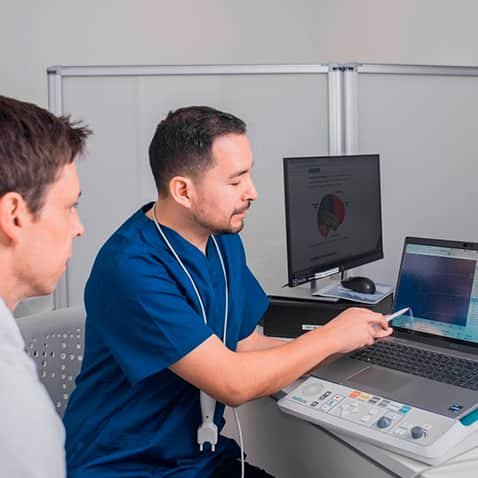
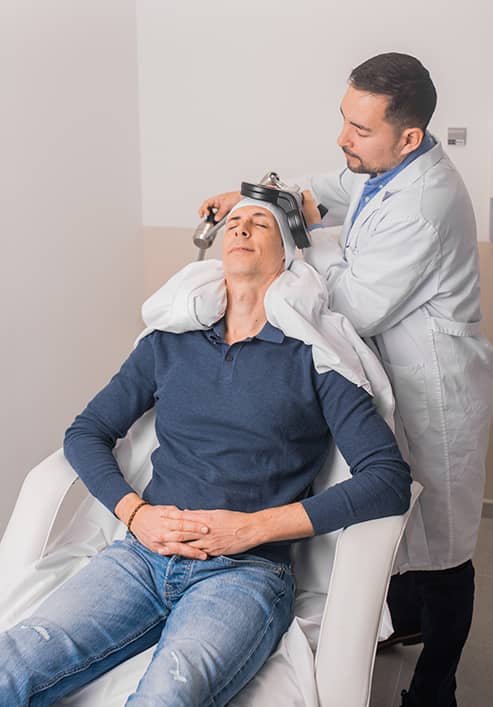
rTMS uses low-intensity magnetic pulses directed at specific areas of the brain. These stimuli generate weak electrical currents that allow for the controlled modification of altered neuronal activity. Thanks to this precision, it is possible to intervene on circuits involved in depression, OCD, addictions, neuropathic pain, fibromyalgia, or post-stroke rehabilitation.
¿Para qué problemas se utiliza la EMTr (TMS)?
rTMS is a widely studied technique that has proven effective in treating various disorders, including:
- Treatment of depression (especially when symptoms persist or there is poor tolerance to previous treatments).
- Treatment of OCD (obsessive-compulsive disorder).
- Treatment of anxiety (generalized anxiety, panic, phobias, social anxiety) and anxiety associated with depression.
- Treatment of chronic neuropathic pain.
- Addictions and craving control, including gambling addiction, as a complement to a comprehensive approach.
- Other indications in evaluation or specific protocols (for example, fibromyalgia, PTSD, Parkinson’s disease or cognitive support), always after clinical assessment.
¿Qué se nota durante la sesión? ¿Duele?
During stimulation, you may feel rhythmic tapping or light pressure on your scalp. It is generally tolerable and not considered painful, although it may be uncomfortable for some people at first. It does not require anesthesia or sedation.
¿Es un tratamiento seguro? ¿Qué efectos secundarios puede tener?
In general, rTMS has a good safety profile when applied according to medical criteria and appropriate protocols. The most common side effects are mild and transient, such as:
- Local discomfort in the area of stimulation.
- Mild headache.
- Tiredness or a feeling of tension after the session.
In less frequent cases, mild dizziness or small facial muscle contractions may occur during stimulation.
Serious complications are rare. Before starting, we review contraindications and risk factors (for example, a history of seizures, certain metallic implants or electronic devices) to maximize safety.
¿Cómo es el proceso desde que contactas con nosotros?
- Initial contact. You write to us or call us and we briefly gather the reason for your inquiry.
- Free consultation. During this first visit, you’ll tell us about your problem in detail: when it started, how it affects you, what treatments you’ve tried, and what the results have been. We’ll review medical reports, tests performed, and relevant medical history.
- Explanation of the procedure. We explain what EMTr/TMS is, what objectives we can set in your case, what the sessions are like, and what you can expect during the application.
- Review of security criteria. We check for contraindications and, if necessary, coordinate information with your specialist doctor.
- Personalized plan. If you agree and meet the requirements, we will define the protocol (area to stimulate, intensity, estimated number of sessions and schedule).
- Start of treatment. In the first session we locate the stimulation points and adjust the necessary parameters (for example, the motor threshold when appropriate). If everything is in order, the first session can take place that same day.
¿Cómo son las sesiones y con qué frecuencia se realizan?
Sessions are usually held daily on weekdays and last approximately 20 to 30 minutes (depending on the protocol). You sit and relax, and the procedure is supervised at all times.
In some indications and protocols, a brief guided activation of symptoms may be performed before or during the session (for example, in certain approaches to OCD) to work more specifically on the circuit involved.
¿Cómo medimos la evolución?
To determine if the treatment is working and to adjust the plan, we use validated clinical scales that allow us to quantify symptoms and changes over time. We conduct regular assessments (at the beginning and during follow-up) to objectively measure your progress.
¿Se puede combinar con medicación, psicoterapia u otros tratamientos?
Yes. TMS is usually integrated as a complementary treatment. It is often combined with psychotherapy, rehabilitation/exercise, or medication when indicated. If you are already being followed by a specialist (psychiatry, neurology, pain unit, etc.), we coordinate the plan to ensure that the treatment is consistent and safe.
¿Cuándo se empiezan a notar los resultados?
It varies depending on the person, the indication, and the protocol. Some people notice changes in the first few weeks, and others notice them later. That’s why we conduct structured follow-up with scales and reviews to adapt the treatment to your response.
Clinical neurophysiology and neuromodulation
- No medications
- Non-invasive
- High response rate
If you would like more information or to schedule a consultation, you can get in touch by phone, WhatsApp, or by filling out the form below.
Vithas Xanit International Hospital
Avenida de los Argonautas, s/n, 29631 Benalmádena, Málaga
Rincón Salud 101
Cam. la Palmilla, 6 (La Rosaleda Stadium), 29011 Málaga